Groundshift is a Swiss investment advisor with deep roots in the European financial industry.
We work with discipline and conviction, identifying off-market opportunities through long-standing institutional relationships and proprietary data models. We validate real demand before an investment is made and support portfolio companies well beyond the initial transaction.
Investment scope
Our focus is financial technology, with room to move when we see exceptional opportunities in adjacent sectors. We look for proven, revenue-generating businesses with the foundations in place to scale.
Stage
Series A or equivalent
Sector
B2B Fintech
Geography
Europe
Our Playbook
01
Demand-driven investing
We don’t guess what the market needs. Through deep relationships with financial institutions and technology partners, we identify real demand and validate companies ahead of any investment decision.
02
Off-market execution
We’re not bound by conventional deal structures or the traditional VC pipeline. Whether through exclusive primaries, secondaries, carve-outs, or structured transactions, we find the right way into the right companies.
03
Active value creation
We go beyond capital. We connect portfolio companies to institutional customers, provide strategic guidance through experienced operators, and build clear paths to exit.
Trusted by founders building the future of finance.
“From the early days to the Ripple acquisition, the Groundshift team was there at every step. They brought real strategic value through their banking relationships and industry knowledge, not just capital.”
Adrien Treccani — Founder
Primary & Secondary at Series A
Acquired by Ripple
“The Groundshift team's network access and the hands-on support were exceptional. They were there through the ups and downs. When we sold to Infront, Alexander ran the process himself. That tells you everything about how involved they really are.”
Massimo Ferrari — Co-Founder
Exclusive Primary (off-market)
Acquired by Infront
“Groundshift recognized the potential of our product while we were still a division within the Halvotec Group and initiated our spin-off in 2021, since then providing the support we needed to grow independently.”
Alexander Lerch — CEO
Carve-out
Live, growing
At a glance
Since 2019, Groundshift has arranged 18 investments across two dedicated funds and two syndications. We maintain active partnerships with over 15 Swiss and European financial institutions and technology partners to identify, validate, and support portfolio companies.
18
Investments arranged
>50%
Off-market transactions
2
Active funds
15+
Institutional partners
Companies we back
01MetacoExited2020
Metaco
Metaco provided bank-grade custody infrastructure for digital assets, enabling institutions such as HSBC, Citi and Raiffeisen to securely hold and manage crypto assets. Acquired by Ripple for $250M in 2023.
Sector
Digital Assets
Stage
Series A
First Invested
2020
Website
—
02AssetmaxExited2020
Assetmax
Assetmax was an integrated software platform for wealth managers, supporting client data management, portfolio analytics and reporting. Customers included Zürcher Kantonalbank and GSI Global Strategic Investments. Sold to Infront.
Sector
WealthTech
Stage
Series A
First Invested
2020
Website
—
03Raquest2021
Raquest
Raquest automates the recovery of foreign withholding taxes on capital income for wealth managers and financial institutions. Customers include Zürcher Kantonalbank and Commerzbank.
Blockpit provides automated crypto tax reporting for retail and institutional investors across Europe. Regulatory tailwinds from CARF and DAC8 are creating mandatory compliance demand.
Blocksize Capital provides institutional-grade digital asset infrastructure, enabling financial institutions to access, trade and manage digital assets.
Wyden is an institutional digital asset trading platform covering the end-to-end trading lifecycle, enabling best execution and minimising counterparty risk.
Storyline is an AI platform for personalised video content in wealth and asset management, using a deterministic implementation to ensure accuracy and regulatory compliance.
NENNA AI is an enterprise AI platform that enables organizations to securely use all major AI models without exposing sensitive data to external providers.
Alexander co-founded Groundshift, formerly known as Avaloq Ventures, in 2019 following a career at SIX, Harcourt, and Partners Group, where he managed open-ended private market funds exceeding CHF 2 billion and advised pension plans on their private market allocation strategies. He has arranged investments in over 10 companies, including Metaco, acquired by Ripple for $250 million. He holds an MSc in Finance from the University of St. Gallen. Outside of work, he spends his time on the water or in the mountains, wing foiling, kitesurfing, hiking, and biking.
Alexandre joined Groundshift at the end of 2024 from a large German fintech venture fund, where he originated and co-led half a dozen Series A and B fintech investments. At Groundshift, he led the investment in Storyline AI, as well as builds and maintains the firm’s proprietary data models, AI-driven sourcing and diligence methodology, drawing on his prior work at Palantir and his engineering background. INSEAD MBA and EPFL alumnus, Alexandre started his career at UBS in Corporate Strategy. Aviation nerd and trained in fluid dynamics, Alexandre spends his time off the desk on the water kitesurfing or wing foiling, and in the mountains on skis.
Daniel joined in 2021 and drives Groundshift’s investment activity in digital-asset and blockchain infrastructure. He was previously COO of Fixposition, an ETH Zurich spin-off, and began his career at Goldman Sachs. He holds a BA in Economics from the University of St. Gallen (HSG). Outside the office, he’s most often skiing, kitesurfing, or out running.
Florian has been part of Groundshift since 2020, managing fund operations, performance tracking, and reporting across its two funds and select co-investment activities. He has been closely involved in seven investments, particularly those with a blockchain technology angle, and oversees the firm’s technology infrastructure and adoption of new operational tools and workflows. He holds an MSc and a BA in Economics from the University of Basel. Outside of work, he plays unihockey, carves the slopes, rallies on the tennis court, and pulls what the team unanimously agrees is the best espresso in the office.
Extended team
Tobias Haeckermann
Growth PartnerCo-Founder, Sherpany (sold to Datasite)
Mathias Brenner
Growth PartnerCo-Founder, Sherpany (sold to Datasite)
Santiago Schuppisser
Technology PartnerCPO, Etops Group (sold to Pollen Street Group)
Thomas Beck
Technology PartnerFormerly Co-CEO Avaloq (sold to NEC)
Advisors
Adrien Treccani
Advisor, IC memberCo-Founder Metaco (sold to Ripple) and Supervised
Francisco Fernandez
Advisor, IC memberCo-Founder Avaloq (sold to NEC)
Massimo Ferrari
AdvisorCo-Founder, Assetmax (sold to Infront)
Pius Stucki
AdvisorCEO and Co-Founder, Etops Group (sold to Pollen Street Group)
Sixteen years of fintech exits in Europe: what the record shows
European fintech is normalising. Sixteen years of exit data explain why that is good news for disciplined investors.
By Alexandre Moreillon · Groundshift · September 2026
What does a good venture outcome actually look like in European fintech? The question sounds basic. Everyone in the industry has an answer from memory: Adyen, Klarna, a decade of unicorn headlines. But almost nobody has one derived from the full record.
As European fintech sees significant shifts, with specialist funds exiting the space and the bulk of venture capital money flowing into AI company, we felt compelled to answer this question for ourselves. So, we ran the numbers and took a close look at realised outcomes instead of hot takes and funding dynamics.
We reviewed sixteen years of data in the vertical. Sufficiently long to articulate a structural response and avoid capturing a single cycle or anecdotes. We analysed the completed exit of all recorded VC-backed fintech, insurtech or crypto company headquartered in the EU-27, the UK, Switzerland or Norway between January 2010 and July 2026: 1’344 exits across sixteen years. The venture test behind “VC-backed” is set out in the methodology note below.
The data is sobering. There were far fewer large exits than the collective mental accounting would suggest. The industry has been blindsided for years by the headlines of newly minted unicorns and premature victory laps. Today we conclude that the real winners of the last sixteen years were first and foremost the capital-efficient and that heavy funding generally predicted poor outcomes.
Much of the capital now leaving fintech was chasing a game the exit record never supported. But what looks like retreat is, for specialist early-stage investors, the ground clearing.
Here’s the evidence.
Big exits are rarer than everyone believes
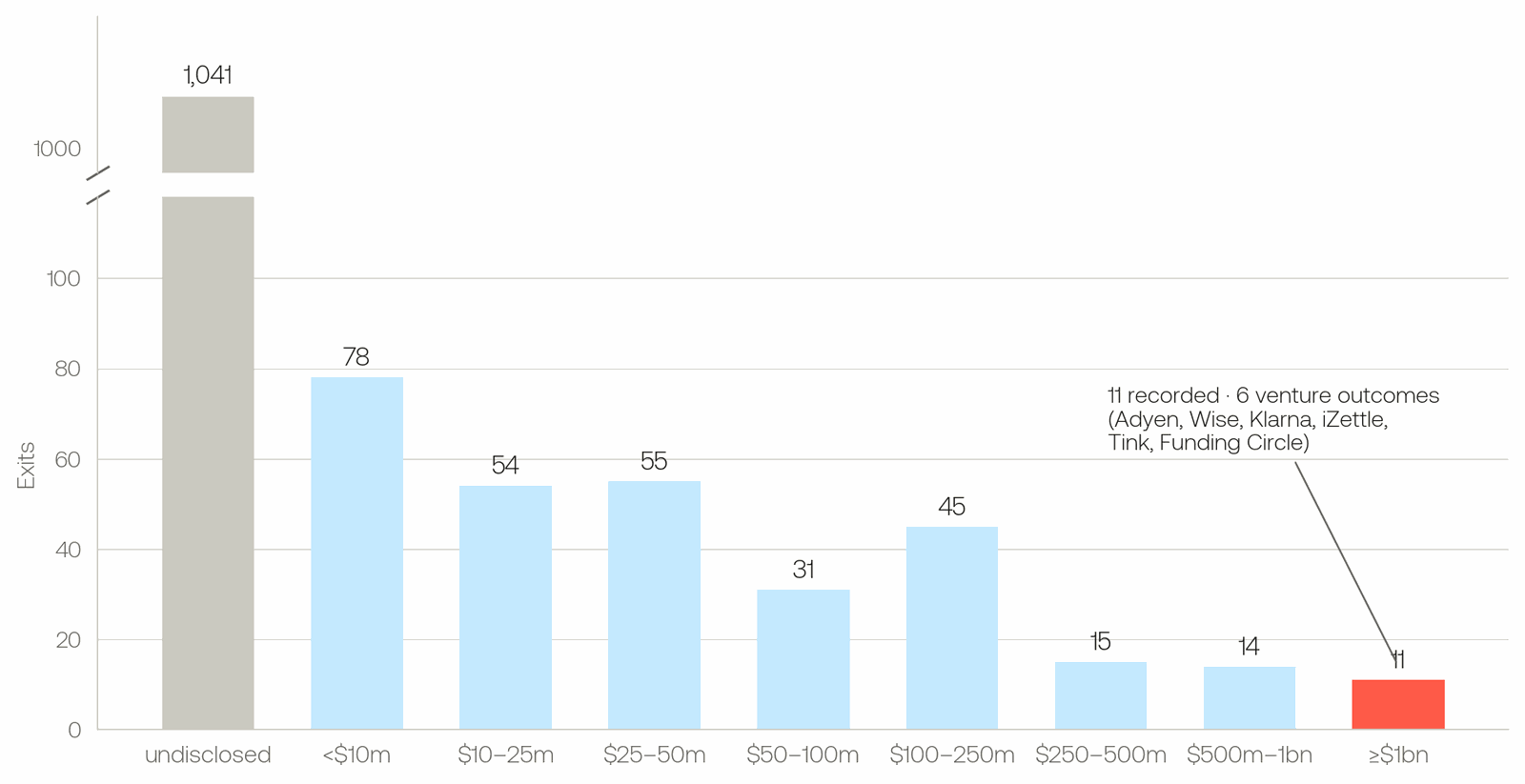
Based on Pitchbook data, sixteen years of European fintech venture produced eleven exits recorded at or above $1bn. Examine them one by one and roughly six survive as true venture products. The other five never went through the end-to-end venture funding cycle: private-equity flips (Skrill, Acuris), a founder-owned business that took late growth capital (Avaloq), a balance-sheet-funded insurance carrier (Inigo), and one effectively US-headquartered company, outside our European scope (CyberSource).
Just six venture exits above $1bn, ever. One every two to three years, across an entire continent. An uncomfortable number for a profession that, for the most part, underwrites only unicorn potential.
Company
Exit route
Year
Realised value
÷ capital raised
Klarna
IPO · NYSE
2025
$15.1bn
3.6x
Wise
Direct listing · London
2021
$11.1bn
14x
Adyen
IPO · Amsterdam
2018
$8.3bn
31x
iZettle
Acquired by PayPal
2018
$2.2bn
6.1x
Funding Circle
IPO · London
2018
$2.0bn
5.4x
Tink
Acquired by Visa
2022
€1.8bn
6.9x
Nutmeg
Acquired by JPMorgan
2021
$986m
5.8x
Ebury
Majority sale to Santander
2019
~$900m implied
~6.7x
Currencycloud
Acquired by Visa
2021
$893m
5.6x
Younited
SPAC listing · Euronext
2025
~$650m
~1.4x
The ten largest verified full-cycle venture-backed exits. The first six rows are the six billion-dollar outcomes referred to above (eleven records reach $1bn; the other five are named in the text); Nutmeg, Ebury, Currencycloud and Younited follow as the largest verified exits below $1bn. Transactions of comparable size that do not appear (among them Dext, Calastone, Meilleurtaux, Banqup, ETF Securities, PayU and LedgerSwarm) fail verification as full-cycle venture exits: private-equity realisations, founder-owned businesses, corporate carve-outs or unverifiable values, each documented in our workings. Multiples are computed on equity capital raised; for iZettle and Funding Circle, whose PitchBook funding totals include large debt facilities (debt-inclusive: 5.0x and 2.5x). Ebury’s figure is the whole-company valuation implied by Santander’s confirmed £350m purchase of 50.1% in 2019, over roughly $134m of equity raised; early investors exited only partially. Younited was valued at its €622m market capitalisation at listing. Nutmeg’s purchase price was never disclosed by the acquirer; the value shown is a PitchBook estimate (press reports put it around £700m).
The romanticised IPO exit is even rarer
Nearly every investment memo sketches a path to the public markets. But the record only shows 46 IPOs in sixteen years, 3.4% of all exits. Worse: forty of them were small and micro-cap listings, most on junior venues such as Nasdaq First North, NGM, Euronext Growth and AIM. Where a value was disclosed, the median was around $40m, and the eleven that stayed silent were smaller still. Those were financing events for small companies rather than exits in any venture sense.
Present in the Pitchbook data as well: IntegraFin and Banqup, listed at about $910m and $720m. Respectable outcomes, but neither tells us much about venture capital: IntegraFin was essentially bootstrapped, having raised barely $0.3m before going public, and Banqup came up through private-equity backing (late-stage growth capital).
True institutional IPO, full-cycle venture-backed, happened four times in sixteen years: Klarna, Wise, Adyen and Funding Circle. That is 0.3% of exits, and only two of the four still trade above their listing value. An exit in European fintech means being bought; the bell-ringing photograph is a rounding error.
Most exits are quiet, and quiet means modest
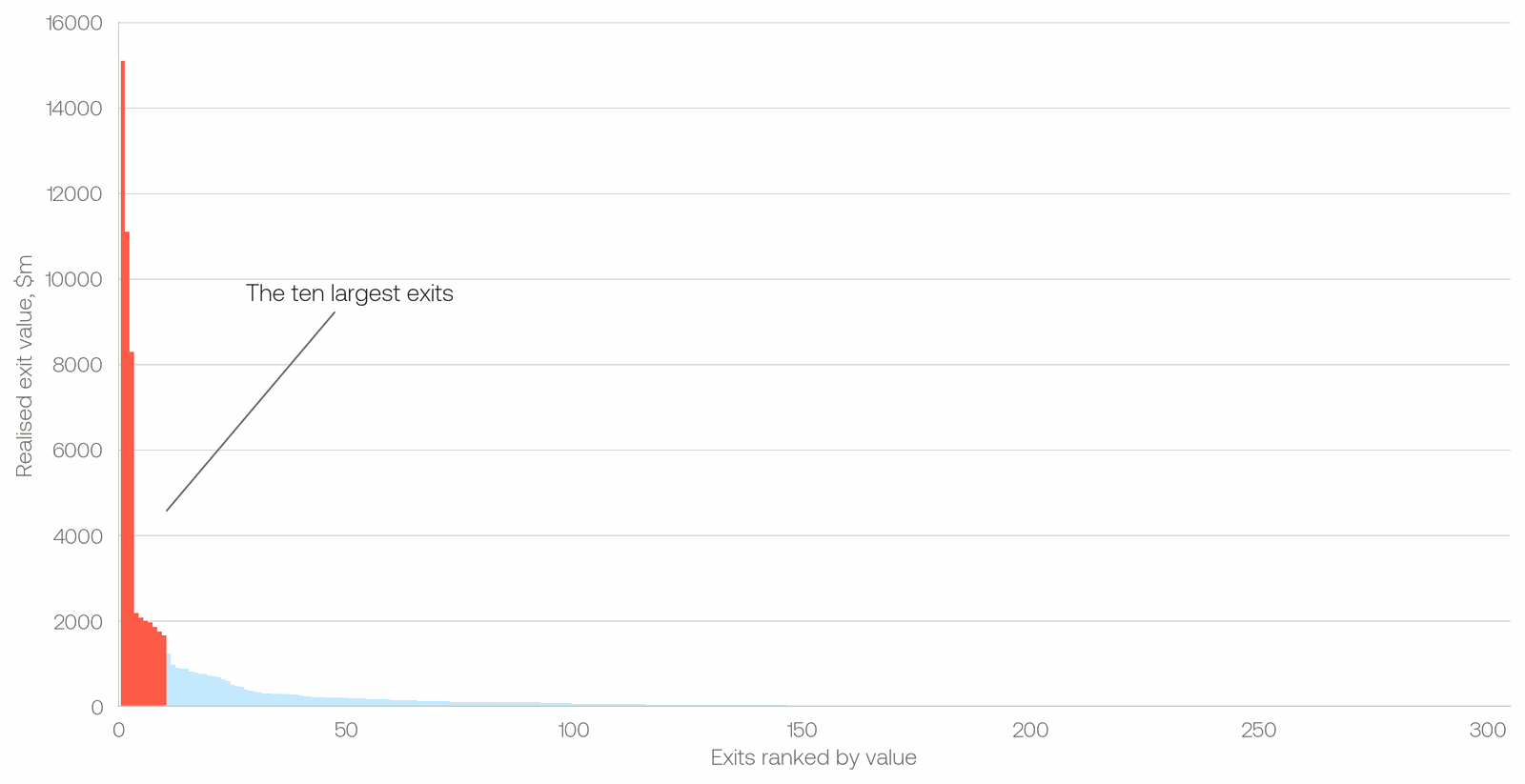
Below the top tier, the aggregate record discloses about one venture-backed exit per year at $500m or better. The median disclosed exit is $33m, and the top ten exits account for 62% of all disclosed value. The top thirty account for 80% of disclosed value, the top hundred for 95%.
Every disclosed exit, ranked: the power law in one picture. 303 disclosed VC-backed exits, realised value in $m, 2010–mid-2026.
And those are the numbers someone chose to publish. 77% of the 1’344 exits carry no value at all, and the silence follows a pattern. Where their funding is recorded, the companies behind undisclosed exits had raised a median of $4.3m, a third of what disclosed ones raised. And only 13% of their acquirers were listed companies, against 44% for disclosed deals.
Both tells point the same way. Listed acquirers must, in most jurisdictions, disclose material transactions; when they stay silent, the price was immaterial. And venture is a vanity game: good outcomes are almost always marketed. The hidden three quarters of the market is best read as acquihires and soft landings, at or below the capital invested.
Sixteen years of VC-backed fintech exits in Europe, by realised value. EU-27, UK, Switzerland and Norway; 1,344 completed exits, 2010–mid-2026.
Capital-efficiency was the standout indicator
A consistent pattern emerged in the PitchBook data. Sector, geography and vintage told us little about outcomes. How much money a company consumed told us a great deal: every additional layer of capital diluted the outcome per dollar.
Lifetime capital raised
Median exit ÷ capital raised
Exits below 1x
Under $10m
5.8x
14%
$10–50m
2.5x
25%
$50–250m
1.4x
45%
Over $250m
0.83x
56%
Disclosed exits with known capital raised only (n = 247). The unannounced majority would presumably sit lower.
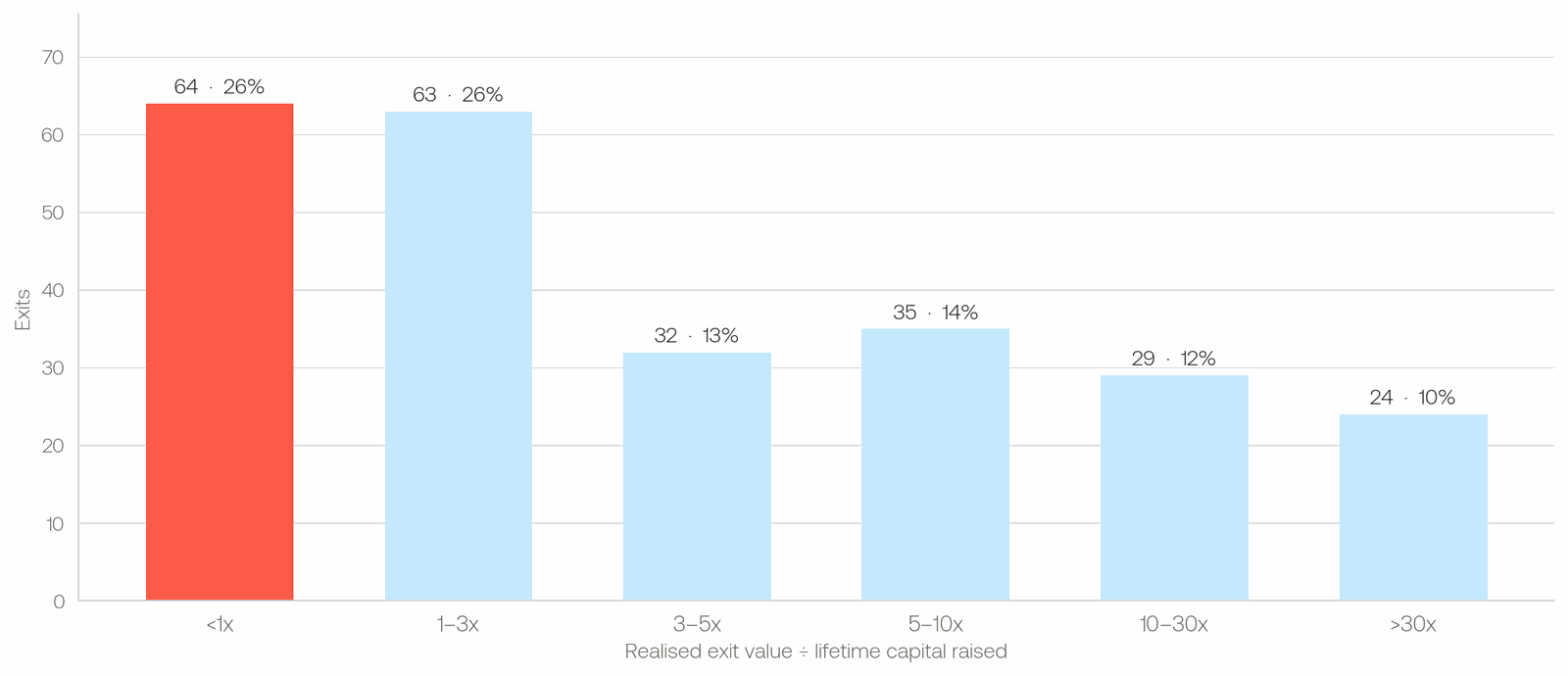
Strikingly, for companies that raised more than $250m, most realised exits returned less than the capital invested. Across all 247 disclosed exits the median is 2.9x, a very generous multiple supported by selection (bragging) bias. Even so, a quarter of announced exits returned less than went into them. The silent majority would presumably skew the distribution even lower.
What stands out, is that the great outcomes were capital-efficient ones: Adyen raised $267m across its life and listed at $8.3bn. Wise raised under $800m and listed at $11.1bn. Tink returned close to 7x its funding when Visa paid €1.8bn. By contrast the capital-hungry cohort either round-tripped (Klarna consumed $4.2bn of capital, peaked at $45.6bn on paper and trades near $5bn today) or sits unpriced on stale 2021 marks.
What an exit returned on the capital that built it. Realised exit value over lifetime capital raised; median 2.9x (sample bias: disclosed exits only)
So what happened to the unicorn cohort?
We define the boom cohort as following: every venture-backed European fintech that completed a priced equity round or secondary at a $1bn+ post-money valuation between January 2020 and December 2022, screened on the same venture test as the full data set (defined in the methodology note). Leveraging Pitchbook data and publicly circulating information, we’ve found 52 of them.
Status in July 2026
Companies
Share
Examples
Exited at or above peak
1
2%
Wise (the only one)
Exited below peak
4
8%
Klarna, GoCardless, Younited
Validated at or above peak in a priced round or secondary, still private
11
21%
Revolut, Trade Republic, Monzo
Repriced below peak in a down round or secondary, still private
6
12%
Checkout.com, Blockchain.com, N26
Crashed or collapsed
3
6%
wefox, Solaris
Zombie · no known priced equity event since the boom
27
52%
Mambu, Pleo, Thought Machine
Definitions: a “priced equity event” is a completed round, secondary or exit; “crashed or collapsed” means an insolvency, forced restructuring or rescue financing that eliminated at least roughly 90% of peak equity value.
Exactly one of the fifty-two, Wise, has exited at or above its peak private mark. Four more exited below it, Klarna at a third of its 2021 peak and GoCardless at roughly 60% among them. Eleven (21% of the cohort) have validated their peak in a priced round or secondary since 2022 and remain private, Revolut, Monzo and Trade Republic among them, though several of those pricings were flat rather than up.
The rest never found their way back to their marks. Six repriced below peak and remain private, Checkout.com, Blockchain.com and N26 among them. Three collapsed: wefox, Solaris and XCAD. And twenty-seven, a majority of the entire vintage, have had no announced priced equity event since the boom: their unicorn valuations are now four or five years old and have never been tested.
Strip out Revolut, whose re-rating to $115bn single-handedly offsets everyone else’s losses, and the vintage’s aggregate paper value is down an estimated 35%, even keeping the untested zombie at face value.
The conclusion is plain: the venture-backed unicorn class of 2020 to 2022 has produced one exit at its promised value (Wise) and one unicorn superstar (Revolut) blinding the entire industry. The rest of the class is mostly stagnant.
Normalisation is the opportunity
European fintech is changing. The capital that entered fintech between 2019 and 2022 (crossover funds, tourist generalists, corporate venture arms assembled in the bull market) is leaving. In less than a quarter this year, PayPal Ventures, Fidelity International Strategic Ventures and Neosfer (Commerzbank) were reported closing. This follows a longer procession of bank and insurance CVCs that stopped writing cheques.
The funding data tells the same story. H1 2026 was the strongest first half since 2022 by value, at $8.5bn invested, yet its 639 recorded rounds are the lowest of any half-year since at least 2018. Fewer cheques, but bigger cheques.
But for those who want to remain, this is good news. Not because the hype is returning, but because the market is finally adjusting for what the record says actually happens.
Sixteen years of data do not support underwriting billion-dollar outcomes; there have been six. They support a disciplined, realist strategy: enter early, at prices consistent with the $200m–1bn acquisitions that payment networks, global banks and financial software consolidators have paid in every market condition. They support backing companies that can win on modest capital, because capital consumption has been the most consistent predictor of a poor outcome in our data. They support treating liquidity as a discipline rather than an event.
Less capital in the market is not a problem for this approach; it is the precondition for it. Entry prices at Series A reflect the marginal buyer, and the marginal tourist buyer is leaving. Specialists who underwrite infrastructure economics rather than funding-round momentum now face less competition for the same companies strategic acquirers have reliably bought for sixteen years.
The unicorn era told European fintech a story about what good looks like. The record tells a humbler one, and we find it considerably more investable.
About the author
Alexandre Moreillon is Partner at Groundshift, where he notably builds the firm’s proprietary data models and its AI-driven sourcing and diligence methodology. He joined at the end of 2024 from a large German fintech venture fund, where he originated and co-led half a dozen Series A and B fintech investments. He previously worked at Palantir and started his career at UBS in Corporate Strategy. He is an INSEAD MBA and an EPFL engineering alumnus.
About Groundshift
Groundshift (formerly FiveT Fintech) is a Zurich-based venture capital firm that backs fintech companies reshaping financial infrastructure across Europe. Founded in 2019, the firm combines deep financial services expertise with a proprietary network of banks, established fintech firms, and industry leaders to source, validate, and scale the next generation of financial technology companies. The team brings over 40 years of combined experience in banking, technology, and venture capital.
This piece was drafted with the help of an AI agent, micro-managed and guided through many iterations. The thesis, the judgment calls and key sentences are human authored. Every figure was verified by the author against the underlying PitchBook records and primary sources. PitchBook itself (Pitchbook Data, Inc.) has not reviewed the data or endorsed the analysis.
PitchBook data as of 28 July 2026; completed M&A, buyout and IPO exits of VC-backed fintech, insurtech and cryptocurrency/blockchain companies headquartered in the EU-27, UK, Switzerland or Norway, January 2010 – July 2026 (n = 1,344). Funding-market figures from PitchBook: European fintech, insurtech and crypto VC and growth rounds, January 2018 – July 2026 (n = 20,482); PitchBook’s Europe definition, wider than the exit scope above.
Venture test (applied to both the exit data set and the unicorn cohort): PitchBook financing status currently or formerly VC-backed, or a first financing of venture type (angel, seed, accelerator, equity crowdfunding, early or later-stage venture capital). A small number of documented judgment overrides corrects companies mis-served by the mechanical rule, such as PE-built platforms.
Exit values were verified against acquirer filings and sourced reporting for all exits above $500m; identified data errors excluded.